Raman Spectroscopy

An introduction to Raman Spectroscopy

Raman Spectroscopy

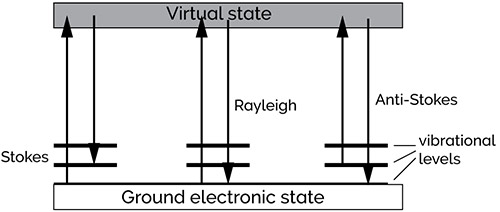
Simplified energy diagram

It is the shift in wavelength of the inelastically scattered radiation that provides the chemical and structural information. Raman shifted photons can be of either higher or lower energy, depending upon the vibrational state of the molecule under study. A simplified energy diagram that illustrates these concepts is shown on the right.

Stokes radiation occurs at lower energy (longer wavelength) than the Rayleigh radiation, and anti-Stokes radiation has greater energy. The energy increase or decrease is related to the vibrational energy levels in the ground electronic state of the molecule, and as such, the observed Raman shift of the Stokes and anti-Stokes features are a direct measure of the vibrational energies of the molecule. A schematic Raman spectrum may appear as shown below.
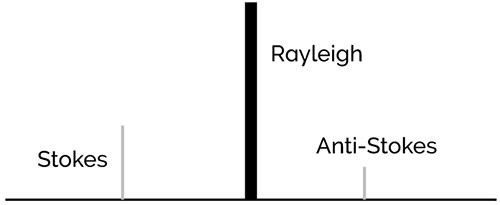
The energy of the scattered radiation is less than the incident radiation for the Stokes line and the energy of the scattered radiation is more than the incident radiation for the anti-Stokes line. The energy increase or decrease from the excitation is related to the vibrational energy spacing in the ground electronic state of the molecule and therefore the wavenumber of the Stokes and anti-Stokes lines are a direct measure of the vibrational energies of the molecule.

In the example spectrum, notice that the Stokes and anti-Stokes lines are equally displaced from the Rayleigh line. This occurs because in either case one vibrational quantum of energy is gained or lost. Also, note that the anti-Stokes line is much less intense than the Stokes line. This occurs because only molecules that are vibrationally excited prior to irradiation can give rise to the anti-Stokes line. Hence, in Raman spectroscopy, only the more intense Stokes line is normally measuredRaman scattering is a relatively weak process. The number of photons Raman scattered is quite small. However, there are several process which can be used to enhance the sensitivity of a Raman measurement.

Raman Spectroscopy

Schematic Raman spectrum

If the wavelength of the exciting laser coincides with an electronic absorption of a molecule, the intensity of Raman- active vibrations associated with the absorbing chromophore are enhanced by a factor of 102 to 104. This resonance enhancement or resonance Raman effect can be extremely useful, not just in significantly lowering the detection limits, but also in introducing electronic selectivety. Thus the resonance Raman technique is used for providing both structural and electronic insight into species of interest. Metalloporphyrins, carotenoids and several other classes of biologically important molecules have strongly allowed electronic transitions in the visible, making them ideal candidates for resonance Raman spectroscopy.Resonance selectivity has a further practical use, in that spectrum of the chromophoric moiety is resonance enhanced and that of the surrounding environment is not. For biological chromophores, this means that absorbing active centres can be specifically probed by visible excitation wavelengths, and not the surrounding protein matrix (which would require UV lasers to bring into resonance). Resonance Raman spectroscopy is also an important probe of the chemistry of metal centred complexes, fullerenes, polydiacetylenes and other "exotic" molecules which strongly absorb in the visible. Although many more molecules absorb in the ultraviolet, the high cost of lasers and optics for this spectral region have limited ultraviolet (UV) resonance Raman spectroscopy to a small number of specialist groups.

Vibrations which are resonantly enhanced fall into two or three general mechanistic classes. The most common case is Franck-Condon enhancement, in which a component of the normal coordinate of the vibration occurs in a direction in which the molecule expands during an electronic excitation. The more the molecule expands along this axis when it absorbs light, the larger the enhancement factor. The easily visualized ring breathing (in-plane expansion) modes of porphyrins fall into this class.Vibrations which couple two electronic excited states are also resonantly enhanced, through a mechanism called vibronic enhancement. In both cases, enhancement factors roughly follow the intensities of the absorption spectrum. The fuller theory of resonance enhancement is beyond the scope of this section.

Resonance enhancement does not begin at a sharply defined wavelength. In fact, enhancement of 5x to 10x is observed if the exciting laser is within even a few 100 wavenumbers below the electronic transition of a molecule. This "pre-resonance" enhancement can be experimentally useful.

The Raman scattering from a compound (or ion) adsorbed on or even within a few Angstroms of a structured metal surface can be 103 to 106x greater than in solution. This surface-enhanced Raman scattering is strongest on silver, but is observable on gold and copper as well. At practical excitation wavelengths, enhancement on other metals is unimportant. SERS arises from two mechanisms:• The first is an enhanced electromagnetic field produced at the surface of the metal. When the wavelength of the incident light is close to the plasma wavelength of the metal, conduction electrons in the metal surface are excited into an extended surface electronic excited state called a surface plasmon resonance. Molecules adsorbed or in close proximity to the surface experience an exceptionally large electromagnetic field. Vibrational modes normal to the surface are most strongly enhanced.• The second mode of enhancement is by the formation of a charge-transfer complex between the surface and analyte molecule. The electronic transitions of many charge transfer complexes are in the visible, so that resonance enhancement occurs.Molecules with lone pair electrons or pi clouds show the strongest SERS. The effect was first discovered with pyridine. Other aromatic nitrogen or oxygen containing compounds, such as aromatic amines or phenols, are strongly SERS active. The effect can also been seen with other electron-rich functionalities such as carboxylic acids.The intensity of the surface plasmon resonance is dependent on many factors including the wavelength of the incident light and the morphology of the metal surface. The wavelength should match the plasma wavelength of the metal. This is about 382 nm for a 5μm silver particle, but can be as high as 600nm for larger ellipsoidal silver particles. The plasma wavelength is to the red of 650nm for copper and gold, the other two metals which show SERS at wavelengths in the 350-1000 nm region. The best morphology for surface plasmon resonance excitation is a small (<100nm) particle or an atomically rough surface.SERS is commonly employed to study monolayers of materials adsorbed on metals, including electrodes. Other popular surfaces include colloids, metal films on dielectric substrates and, recently, arrays of metal particles bound to metal or dielectric colloids through short linkages. Although SERS allows easy observation of Raman spectra from solution concentrations in the micromolar (10x-6) range,non- reproducability of quantitative measurements has in the past marred its utility for analytical purposes. However,standardization in production of SERS active media is steadilyimproving its potential in this area also.

UVRRS is a powerful tool in the molecular analysis of complex biological systems. Most biological systems absorb UV radiation and hence have the ability to offer resonance with UV Raman excitation.This results in the highly selective resonance Raman effect enabling enhancement of important biological targets such as protein or DNA. For example, excitation around 200nm enhances the Raman peaks from vibrations of amide groups; excitation around 220nm enhances peaks from certain aromatic residues.The Raman scatter from water is weak, allowing for analysis of very weak aqueous systems.
Raman Spectroscopy

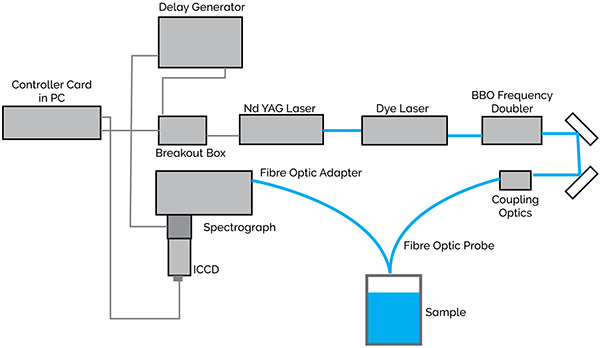
Fiber optic UVRRS configuration

Due to the selective nature of UVRRS, a tunable laser is typically required as the excitation source. Since truly tunable continuous-wave lasers are not yet available, a Nd:YAG-pumped dye laser with frequency-doubled output is one suitable UVRRS system.Depending on the dyes used, this laser setup can give almost any required UV wavelength.Intensified CCDs (ICCDs) with UV photocathodes, back-illuminated CCDs or CCDs with UV enhancing (BASF lumogen)coatings can be used as detectors for UVRRS. These detectors are used on account of their high detection efficiency and multichannel capabilities.The primary obstacle to the merging of the worlds of UVRRS and fiber-optic spectroscopy is solarization, the process by which UV radiation causes opacity of fiber-optics (even quite pure silica fibers). This opacity impairs transmission, rendering standard fiber-optics useless for UVRRS.

Vibrational Raman spectroscopy is now widely recognised as a useful technique for chemical analysis of stable species, since the technology which underpins Raman measurements has matured. Similarly, time-resolved Raman spectroscopy has also become established as an excellent method for the characterization of transient chemical species.Many of the technical advances which have reduced the cost and increased the reliability of conventional Raman systems can also be exploited in studies of transient species.

Raman Spectroscopy

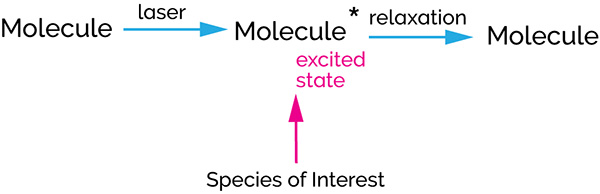
Species of Interest

Pulsed lasers are typically utilized in the study of short-lived species. A laser pulse can be supplied to a molecular system with enough energy to redistribute the electrons in a molecule causing the formation of an excited state as illustrated on the right. The Raman spectrum of this excited state molecule can be studied either using the same laser pulse or a different pulse from a second laser (single color and two-color pulsed Raman).Excited states of interest can have lifetimes, from picoseconds to milliseconds, but the majority can be studied using gating in the order of 5ns. As the majority of excited states are generated using UV and visible lasers, photocathodes with high UV and visible Quantum Efficiencies (QE's) are typically suitable.

Raman Spectroscopy

Schematic of basic pulsed excited state Raman

The simplest pulsed laser experiments are so-called single- color experiments where high irradiance laser pulses are used both to initiate the photoreaction, and then to Raman probe the transient species created within the pulse width.By opening the intensifier tube as shown on the right, only the Raman spectrum of the excited state will be recorded. This pulse/ICCD gate combination will be repeated and accumulated hundreds to thousands of times in order to achieve a good overall signal-to-noise ratio with high dynamic range.

Raman Spectroscopy

Schematic of pump-probe (two color) Raman

In Time Resolved Resonance Raman (TR3) spectroscopy, pairs of laser pulses of different wavelength are used to photolyse (optically "pump") and then to Raman probe the transient species of interest.The spectral window of the spectrograph/detector is chosen so that it corresponds to the frequency range of the Raman scattering from the probe laser.
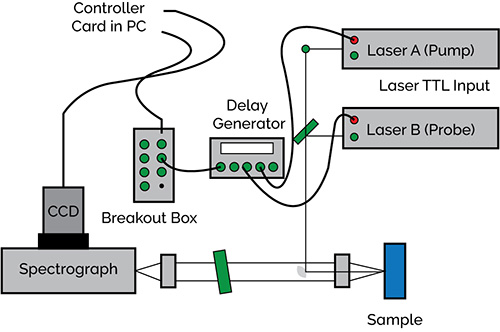
In Time Resolved Resonance Raman (TR3) spectroscopy, pairs of laser pulses of different wavelength are used to photolyse (optically "pump") and then to Raman probe the transient species of interest.The spectral window of the spectrograph/detector is chosen so that it corresponds to the frequency range of the Raman scattering from the probe laser.

Raman Spectroscopy

Pulsed two color Raman layout with delays under the control of a delay generator

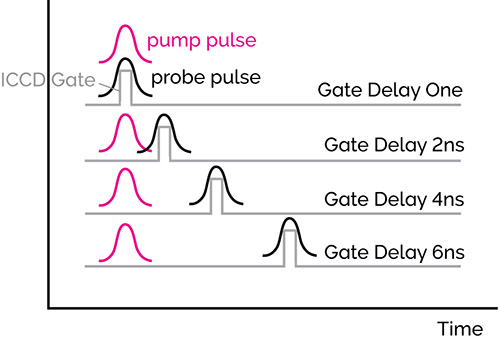
The time evolution of the transient signal is monitored by recording a series of spectra at different delays after the photolysis event, i.e. at a series of time delays between the excitation and probe pulses. The ICCD camera or either of the lasers can supply the trigger.A delay generator is used to controls the delays.

Raman Spectroscopy

Time delay sequences

In Raman microscopy, a research grade optical microscope is coupled to the excitation laser and the spectrometer, thus producing a platform capable of obtaining both conventional images and in addition generating Raman Spectra from sample areas approaching the diffraction limit (~1 micron). Imaging and spectroscopy can be combined to generate "Raman cubes", 3- dimensional data sets, yielding spectral information at every pixel of the 2D image.A motorized xyz microscope stage can be used to automatically record spectral files, which will constitute the basis of Raman images, Raman maps or a set of Raman spectra recorded from preselected points. Specific software routines will allow the quick and easy reconstruction of these maps.The possibility of generating two-dimensional and three-dimensional images of a sample, using various special features, is an evident advantage over either traditional spectroscopy or microscopy.

The first ever Raman "instrument" was constructed in 1928. This instrument used monochromatized sunlight as a light source and a human eye as a detector. Raman instrumentation was developed (based around arc lamps and photographic plates) and soon became very popular up until the 1950's.Since these early days, Raman instrumentation has evolved markedly. Modern instrumentation typically consists of a laser, Rayleigh filter, a few lenses, a spectrograph and a detector (typically a CCD or ICCD).

Raman Spectroscopy

Typical Continuous Wave (CW) Raman layout

One of the major advantages of dispersive Raman is that it offers the possibility to select the optimal laser excitation wavelength to permit the recording of the best Raman information. For example, wavelengths can be selected to offer the best resonance with the sample under investigation.

One might also need to tune wavelength to avoid fluorescence and thermal emission backgrounds.Nowadays, it is possible to use laser lines from UV, (down to 200nm) up to the infrared, (1.06μm Nd:YAG laser line), from microWatts up to several Watts..

Publications Database
Chetan A. PatilA clinical instrument for combined raman spectroscopy optical coherence tomography of skin cancers2011
Toshiaki MasudaUltra-high residual compressive stress (>2 GPa) in a very small volume (<1 µm3) of indented quartz 2011
K. L. Andrew ChanTip-enhanced Raman mapping with top-illumination AFM2011
V. V. PullyTime lapse Raman imaging of single live lymphocytes2011
Wilson A. CrichtonThe crystal structure of barite, BaSO4, at high pressure2011
Zhen-yi ChenSurface-enhanced Raman scattering sensor based on fused biconical taper zone of optical fiber2011
Lee Hee-OkSurface Enhanced Raman Scattering from Porous Gold Nanofibers of Different Diameters2011
Jian DingStructural and optical properties of porous iron oxide2011
Jing WangSpectroscopic Ultra-Trace Detection of Nitroaromatic Gas Vapor on Rationally Designed Two-Dimensional Nanoparticle Cluster Arrays2011
O. S. KnauerSimultaneous determination of the composition and temperature gradients in the vicinity of boiling bubbles in liquid binary mixtures using one-dimensional Raman measurements 2011
Philipp GrafSilicification of Peptide-Coated Silver Nanoparticles—A Biomimetic Soft Chemistry Approach toward Chiral Hybrid Core Shell Materials 2011
Alexey F. BunkinShip wake detection by Raman lidar 2011
Christa L. Brossea...Revealing the invisible: using surface enhanced Raman spectroscopy to identify minute remnants of color in Winslow Homer's colorless skies2011
Carolina ZiparoRaman spectroscopy study of molecular hydrogen solubility in water at high pressure2011
Aliz KunstarRaman Microspectroscopy – A Non-Invasive Analysis Tool For Monitoring Of Collagen-Containing Extracellular Matrix Formation in a Medium-Throughput Culture System 2011
Qihong ZhangRaman microspectroscopic and dynamic vapor sorption characterization of hydration in collagen and dermal tissue2011
Young Jong LeeQuantitative Image Analysis of Broadband CARS Hyperspectral Images of Polymer Blends2011
Jacqueline Ferreir...Probing speciation inside a conducting polymer matrix by in situ spectroelectrochemistry2011
Chia-Yu LinPicosecond spectral coherent anti-Stokes Raman scattering imaging with principal component analysis of meibomian glands2011
Niels Holten-Ander...pH-induced metal-ligand cross-links inspired by mussel yield self-healing polymer networks with near-covalent elastic moduli2011
Bo YanOptimizing Gold Nanoparticle Cluster Configurations (n 7) for Array Applications2011
J. Renwick BeattieOptimising reproducibility in low quality signals without smoothing; an alternative paradigm for signal processing2011
Kevin G. Stampleco...Optimal Size of Silver Nanoparticles for Surface-Enhanced Raman Spectroscopy 2011
Sezhian Annamalai ...Optical and transport properties of xCuO.(1x) Li2B4O7 glasses2011
Sergey S. Kharints...Near-field optical taper antennas fabricated with a highly replicable ac electrochemical etching method2011
Aidan J. RossMicroRaman spectroscopy of diamond and graphite in Almahata Sitta and comparison with other ureilites2011
Sergei M. PershinIntensity redistribution of bending and stretching Raman scattering bands in water upon degassing and crystallisation2011
Ghizal F. AnsariIntense Upconversion Luminescence of Yb 3+-Er 3+ in Li 2 O Content Tungsten-tellurite Glasses2011
Chetan A. PatilIntegrated system for combined Raman spectroscopy–spectral domain optical coherence tomography2011
Maggy Dutreilh-Col...In Situ Raman Diagnostic of Structural Relaxation Times of Silica Glasses2011
Xianxu ZhengHigh Pressure Vibrational Spectroscopy of Hexahydro 1, 3, 5 Trinitro 1, 3, 5 Triazine (RDX)2011
Hung-Chieh ChengHigh-Quality Graphene p n Junctions via Resist-free Fabrication and Solution-Based Noncovalent Functionalization 2011
Hans U. StaufferGas-phase thermometry using delayed-probe-pulse picosecond coherent anti-Stokes Raman scattering spectra of H2 2011
Stephan RichterFunctional plant cell wall design revealed by the Raman imaging approach2011
Michael P. Cecchin...Flow-Based Autocorrelation Studies for the Detection and Investigation of Single-Particle Surface-Enhanced Resonance Raman Spectroscopic Events 2011
Jiha SungFast three dimensional chemical imaging by interferometric multiplex coherent anti Stokes Raman scattering microscopy2011
Zhuyuan WangExperimental indication of chemical effects in surface enhanced hyper Rayleigh scattering using dye-adsorbed Ag nanoparticles2011
Sergei M PershinEvolution of the spectral component of ice in the OH band of water at temperatures from 13 to 99° C2011
Praveen C. AshokEnhanced bioanalyte detection in waveguide confined Raman spectroscopy using wavelength modulation 2011
Younghun JungElectrical and optical characterization of GaN microwires2011
Ann-Kathrin Knigge...Effects of ethanol, formaldehyde, and gentle heat fixation in confocal resonance Raman microscopy of purple nonsulfur bacteria2011
Mathew P. ThariyanDual-pump coherent anti-Stokes Raman scattering system for temperature and species measurements in an optically accessible high-pressure gas turbine combustor facility 2011
Zhuyuan WangDual-mode Probe Based on Mesoporous Silica Coated Gold Nanorods for Targeting Cancer Cells2011
Piotr J. MakDefining CYP3A4 Structural Responses to Substrate Binding. Raman Spectroscopic Studies of a Nanodisc-Incorporated Mammalian Cytochrome P450 2011
S. SinanisCharacterization of Multicomponent Aerosols by Raman Spectroscopy2011
Taejoon KangAu Nanowire-on-Film SERRS Sensor for Ultrasensitive Hg2+ Detection2011
Timur ShegaiAngular Distribution of Surface-Enhanced Raman Scattering from Individual Au Nanoparticle Aggregates2011
Praveen C. AshokWaveguide confined Raman spectroscopy for microfluidic interrogation2011
Amit SharmaVibrational Study of Rhodamine 6G and Effect of Methanol on its Vibrational Spectra2011
J. KlossaUsing biophotonics techniques to retrieve prognostic intracellular signatures2011
H. BensaidX-ray structure refinement of solid solution Ba2.15 xNa0.7+xNb5 xWxO15 and the investigation of the orthorhombic-tetragonal phase transition by Raman spectroscopy 2010
A. EzzahiX-ray diffraction and Raman spectroscopy studies of BaSrMWO6 (M = Ni, Co, Mg) double perovskite oxides 2010
Marleen M. Kerssen...Towards a safe non-invasive method for evaluating the carbonate substitution levels of hydroxyapatite (HAP) in micro-calcifications found in breast tissue2010
Yeny A. TobonTime-resolved Raman studies on Al2O3: Cr3+: lifetime measurements of the excited-state transition 2 2010
Peter H. SiegelTHz in Biology and Medicine: Towards Quantifying and Understanding the Interaction of Millimeter- and Submillimeter-Waves with Cells and Cell Processes2010
V. PikovThermal Monitoring: Raman Spectrometer System for Remote Measurement of Cellular Temperature on a Microscopic Scale2010
David A. McKeownTheoretical determination of the Raman spectra of single-crystal forsterite (Mg2SiO4) 2010
Gabor BalázsTheoretical and Spectroscopic Investigation of Coordination Compounds from P4S3, Copper(I) Iodide and W(CO)5 2010
C. K. NajeebThe effect of surface modifications of carbon nanotubes on the electrical properties of inkjet-printed SWNT/PEDOT–PSS composite line patterns2010
A. ShahTemperature optimization and characterization of MBE grown GaN thin film on c-plane sapphire Al2O3 (0001) with Ga metallic buffer layer2010
Thorsten M. GesingTemperature dependent structural and spectroscopic studies of sodium gallosilicate nitrite sodalite2010
Chunyuan SongTagged molecule induced nanoparticle aggregation: Raman reporter-labeled immuno-Au aggregate as immuno-sensor2010
Koji MaruyamaSynthesizing a composite material of amorphous calcium carbonate and aspartic acid 2010
B. ManounaSynthesis, structure and high temperature Mössbauer and Raman spectroscopy studies of Ba1.6Sr1.4Fe2WO9 double perovskite 2010
B. Manoun Synthesis, Rietveld refinements and Raman spectroscopic studies of tricationic lacunar apatites Na1-xKxPb4(AsO4)3 (0 x 1) 2010
Tiwari V.S.Study of surface enhanced Raman scattering (SERS) within hollow core photonic crystal fiber2010
Silvia TardioliStructure elucidation of fluorescent H1 antihistamines by ultraviolet resonance Raman spectroscopy: solvent structures of tripelennamine and mepyramine 2010
Ning SunSolvation Effects on S K-Edge XAS Spectra of Fe S Proteins: Normal and Inverse Effects on WT and Mutant Rubredoxin2010
Edward T. BraniganSolidlike coherent vibronic dynamics in a room temperature liquid: Resonant Raman and absorption spectroscopy of liquid bromine2010
Javier MorosSimultaneous Raman Spectroscopy Laser-Induced Breakdown Spectroscopy for Instant Standoff Analysis of Explosives Using a Mobile Integrated Sensor Platform2010
A. H. MoharramShort and intermediate range order of GeSeTe glasses2010
Annette MeinersShedding light into adhesive optimization of material interfaces by plasma treatment2010
Manikantan Syamala...Selective Detection of HbA1c Using Surface Enhanced Resonance Raman Spectroscopy 2010
Jayakumar Onattu D...Room Temperature Ferromagnetism in Ce1 xFexO2 (x = 0.0, 0.05, 0.10, 0.15 and 0.20) Nanoparticles Synthesised by Combustion Method 2010
Marcel LucasReversible swelling of the cell wall of poplar biomass by ionic liquid at room temperature 2010
Victor PikovRemote Temperature Monitoring of Cells Exposed to Millimeter-Wave Radiation using Microscopic Raman Spectroscopy2010
Michael L. Ramírez...Remote Detection of Hazardous Liquids Concealed in Glass and Plastic Containers2010
S. StöckelRaman Spectroscopy-Compatible Inactivation Method for Pathogenic Endospores2010
Rachael HallRaman spectroscopy based clinical study of healthy human volunteer skin sites using a fiber optic probe 2010
Salma BedouiRaman spectroscopic and optical imaging of high spin/low spin domains in a spin crossover complex2010
Jan Jehli?kaRaman spectra of pure biomolecules obtained using a handheld instrument under cold high-altitude conditions2010
Anna Chiara Brunet...Raman Scattering in a Dimethyl Sulfoxide-Filled Hollow-Core Photonic Crystal Fiber2010
Nicholas David Mag...Raman microscopy in the diagnosis and prognosis of surgically resected nonsmall cell lung cancer2010
Andrey V. KorsakovRaman-based geobarometry of ultrahigh-pressure metamorphic rocks: applications, problems, and perspectives2010
Mekhala Raghavan Quantitative polarized Raman spectroscopy in highly turbid bone tissue2010
Chunyuan SongPreparation of 2-mercaptobenzothiazole-labeled immuno-Au aggregates for SERS-based immunoassay 2010
Fang ZhangOn the fluorescence of C60 at room temperature2010
Igor I. VlasovNitrogen and Luminescent Nitrogen-Vacancy Defects in Detonation Nanodiamond2010
Heli LeinonenNew nitrene functionalizations onto sidewalls of carbon nanotubes and their spectroscopic analysis2010
Xianxu ZhengNanosecond time-resolved Raman spectroscopy of molecular solids under laser-driven shock compression 2010
Maxwell ZimmerleyMolecular Orientation in Dry and Hydrated Cellulose Fibers: A Coherent Anti-Stokes Raman Scattering Microscopy Study2010
Jens SuffnerMicrostructure Evolution During Spark Plasma Sintering of Metastable (ZrO2–3 mol% Y2O3)–20 wt% Al2O3 Composite Powders 2010
Jie RuMicrofabrication and Characterization of Carbon/Molecule/Metal Molecular Junctions2010
Brian A. RosenLow temperature electrocatalytic reduction of carbon dioxide utilizing room temperature ionic liquids2010
Xinwei CuiLengthening and Thickening of Multi-walled Carbon Nanotube Arrays Grown by Chemical Vapor Deposition in the Presence and Absence of Water2010
Laser Based Stand-Off Detection of Biological Agents2010
Thuc T. LeLabel-free quantitative analysis of lipid metabolism in living Caenorhabditis elegans2010
James P. R. DayLabel-Free Imaging of Lipophilic Bioactive Molecules during Lipid Digestion by Multiplex Coherent Anti-Stokes Raman Scattering Microspectroscopy2010
Ossi LehtinenIon irradiation of multi-walled boron nitride nanotubes2010
Paul S. Hsu Investigation of optical fibers for coherent anti-Stokes Raman scattering (CARS) spectroscopy in reacting flows 2010
Heng ChiInter-residue Coupling and Equilibrium Unfolding of PPII Helical Peptides. Vibrational Spectra Enhanced with 13C Isotopic Labeling2010
J. ChaikenInstrument for near infrared emission spectroscopic probing of human fingertips in vivo2010
Mathew FhanerImprovements in the formation of boron-doped diamond coatings on platinum wires using the Novel Nucleation Process (NNP)2010
Bo YanIdentification of Tumor Cells through Spectroscopic Profiling of the Cellular Surface Chemistry2010
Bouchaib ManounHigh temperature Raman spectroscopy studies of the phase transitions in Sr2NiWO6 and Sr2MgWO6 double perovskite oxides2010
Mingliang JinHigh-Density Periodic Arrays of Self-Aligned Subwavelength Nanopyramids for Surface-Enhanced Raman Spectroscopy 2010
Raktim DasguptaHemoglobin degradation in human erythrocytes with long-duration near-infrared laser exposure in Raman optical tweezers 2010
Jitendra Kumar Chi...Hairy foam : thin layers of carbon nanofibers as catalyst support for liquid phase reactions2010
Shashwati SenGrowth of SnO2/W18O49 nanowire hierarchical heterostructure and their application as chemical sensor2010
Konstantin Christo...Fabrication and Characterization of Homogeneous Surface-Enhanced Raman Scattering Substrates by Single Pulse UV-Laser Treatment of Gold and Silver Films2010
Kowtilya BijjulaExperimental investigation of the reactive flow field around catalytic micro-wires for intermediate Reynolds-number flows2010
Yvonne HalpinExcited State Localization and Internuclear Interactions in Asymmetric Ruthenium(II) and Osmium(II) bpy/tpy Based Dinuclear Compounds2010
Weimin ZhouEnhanced efficiency of light emitting diodes with a nano-patterned gallium nitride surface realized by soft UV nanoimprint lithography2010
Ann-Kathrin Knigge...Hierarchical Cluster Analysis (HCA) of Microorganisms: An Assessment of Algorithms for Resonance Raman Spectra2010
Barry CreanElucidation of the internal physical and chemical microstructure of pharmaceutical granules using X-ray micro-computed tomography, Raman microscopy and infrared spectroscopy 2010
Mathew P. ThariyanDual-pump CARS temperature and major species concentration measurements in counter-flow methane flames using narrowband pump and broadband Stokes lasers2010
M. Larraona-PuyDiscrimination between basal cell carcinoma and hair follicles in skin tissue sections by Raman micro-spectroscopy2010
Yasutaka KitahamaDifference in time dependence of surface-enhanced Raman scattering spectra of thiacarbocyanine J- and H-aggregates adsorbed on single silver nanoaggregates 2010
Andrey V. KorsakovDiamond-Graphite Relationships in Ultrahigh-pressure Metamorphic Rocks from the Kokchetav Massif, Northern Kazakhstan2010
A. ZoladekDevelopment of Raman Imaging System for time-course imaging of single living cells 2010
Xin ZhangDevelopment and deployment of a deep-sea Raman probe for measurement of pore water geochemistry2010
Jason R. MaherDetermination of Ideal Offset for Spatially Offset Raman Spectroscopy2010
Hainer WackerbarthDetection of explosives based on surface-enhanced Raman spectroscopy2010
Akira HosodaDetection of ER stress in vivo by Raman spectroscopy2010
Masashi YoshinagaDeposited carbon distributions on nickel film/oxide substrate systems2010
A. MerlinoCrystallization, preliminary X-ray diffraction studies and Raman microscopy of the major haemoglobin from the sub-Antarctic fish Eleginops maclovinus in the carbomonoxy form 2010
M. AzdouzCrystal chemistry, Rietveld refinements and Raman spectroscopy studies of the new solid solution series: Ba3 xSrx(VO4)2 (0 x 3) 2010
Hoshino MihokoCrystal chemistry of zircon from granitic rocks, Japan: genetic implications of HREE, U and Th enrichment2010
Zhihang ChenCr-MnOx mixed-oxide catalysts for selective catalytic reduction of NOx with NH3 at low temperature2010
Christoph KrafftCrisp and soft multivariate methods visualize individual cell nuclei in Raman images of liver tissue sections2010
Kostka F.Control system of the Raman spectrograph2010
Atsuko TsurumiConstruction of Multichannel Low Frequency Raman Microspectrometer of Spectral Coverage to 20 cm with Gratings Formed in Glass Plates2010
N. R. ButtClassification of Raman Spectra to Detect Hidden Explosives2010
Amir WandChirp effects on impulsive vibrational spectroscopy: a multimode perspective2010
Bi-Chang ChenChemical Imaging with Frequency Modulation Coherent Anti-Stokes Raman Scattering Microscopy at the Vibrational Fingerprint Region2010
Suranan Anantachai...Chemical and structural investigation of lipid nanoparticles: drug–lipid interaction and molecular distribution 2010
Michael D. Hargrea...Characterisation of Transmission Raman Spectroscopy for Rapid Quantitative Analysis of Intact Multi-component Pharmaceutical Capsules 2010
Martin P. FethChallenges in the development of hydrate phases as active pharmaceutical ingredients – An example 2010
Hainer WackerbarthChallenge of false alarms in nitroaromatic explosive detection—a detection device based on surface-enhanced Raman spectroscopy2010
Kazuhiro TadaBroadband Coherent Anti-Stokes Raman Scattering Spectroscopy Using a Quasi-Supercontinuum Light Source 2010
Xuebin TanBiocompatible and stable core/shell drug nanocarrier with high surface-enhanced Raman scattering activity2010
Taejoon KangAu Nanowire–Au Nanoparticles Conjugated System which Provides Micrometer Size Molecular Sensors2010
Madhav Vasanthavad...Application of melt granulation technology using twin screw extruder in development of high dose modified release tablet formulation2010
Song YijianAnisotropic Growth and Formation Mechanism Investigation of 1D ZnO Nanorods in Spin-Coating Sol-Gel Process 2010
Naveed R. ButtAn improved classification scheme for standoff detection of explosives via Raman Spectroscopy2010
Maria S. AgathouAn experimental comparison of non-premixed bio-butanol flames with the corresponding flames of ethanol and methane2010
Sebastian BuschAnalysis of self-repair mechanisms of Phaseolus vulgaris var. saxa using near-infrared surface-enhanced Raman spectroscopy2010
Indranil LahiriAn all-graphene based transparent and flexible field emission device 2010
Kelvin YenA Comparative Study of Fat Storage Quantitation in Nematode Caenorhabditis elegans Using Label and Label-Free Methods2010
David M. ColesA Characterization of the Raman Modes in a J-Aggregate-Forming Dye: A Comparison between Theory and Experiment2010
V. V. PullyRaman-fluorescence hybrid microspectroscopy of cell nuclei2009
Z IoffeDetection of heating in current-carrying moleculer junctions by Raman scattering2008
V. PikovVA Simple System for Remote Temperature Monitoring of Cells using Microscopic Raman Spectroscopy2008
K. Eremin Examination of pigments on Thai manuscripts: the first identification of copper citrate2008
S. SrinivasanImage-guided Raman spectroscopic recovery of canine cortical bone contrast in situ2008
B. SepúlvedaShape effects in the localized surface plasmon resonance of single nanoholes2008
F. RwereThe Impact of Altered Protein-Heme Interactions on the Resonance Raman Spectra of Heme Proteins. Studies of Heme Rotational Disorder2008
E StjernschantzStructural rationalization of novel drug metabolizing mutants of cytochrome P450 BM3 2008
A BonifacioActive-site structure, binding and redox activity of the heme– thiolate enzyme CYP2D6 immobilized on coated Ag electrodes: a surface-enhanced resonance Raman scattering study2008
ZR AbramsA Complete Scheme for Creating Predefined Networks of Individual Carbon Nanotubes2007
K.M. Balss Quantitative spatial distribution of sirolimus and polymers in drug-eluting stents using confocal Raman microscopy2007
M. V. SchulmerichSubsurface and Transcutaneous Raman Spectroscopy and Mapping Using Concentric Illumination Rings and Collection with a Circular Fiber-Optic Array2007
N. Mironova-UlmaneRaman scattering in nanosized nickel oxide NiO2007
T. SakaeAnalysis of liquid specimen in a glass ampoule by 532nm Micro-FT-Raman2007
E.R. AndresenFiber laser-based light source for coherent anti-Stokes Raman scattering microspectroscopy2007
P. MatousekProspects for the diagnosis of breast cancer using transmission Raman spectroscopy2007
C. EliassonNon-invasive detection of counterfeit drugs using Spatially Offset Raman Spectroscopy2007
A BonifacioSurface-Enhanced Resonance Raman Scattering of Cytochrome P450-2D6 on Coated Silver Hydrosols2007
A NiiliskRaman characterization of strain in epitaxial Cr2O3 films on sapphire2007
DA WatsonA Flow Cytometer for the Measurement of Raman Spectra2007
M. V. SchulmerichTranscutaneous fiber optic Raman spectroscopy of bone using annular illumination and a circular array of collection fibers2006
L. M. LeveringA VIBRATIONAL SPECTROSCOPIC STUDY OF AQUEOUS HYDROGEN HALIDE SOLUTIONS: APPLICATION TO ATMOSPHERIC AEROSOL CHEMISTRY2005
P. MATOUSEKSubsurface Probing in Diffusely Scattering Media Using Spatially Offset Raman Spectroscopy2005
D. HutsebautRaman microspectroscopy as an identification tool within the phylogenetically homogeneous ‘Bacillus subtilis’-group
Sheri WhiteLaser Raman instrumentation for in situ Geochemical Analyses in the Deep Ocean
Amanda JenkinsGemstone Identification using Raman Spectroscopy
E. LevinaChemical components in a mixture by maximum likelihood
DAVID A. MCKEOWNvibrational analyses of albite
Phillip OlkOptical Properties of Nano-Sized Partical Pairs
C. EliassonDetection of counterfeit drugs
Jozsef GaraiInvestigating the optical properties of carbonado-diamonds
Georgi I. PetrovComparison Raman microspectroscopies for noninvasive detection bacterial endospores
Wesley R. BrowneProbing inter-ligand excited state interaction
E R C DraperNovel assessment of bone quality
N. Mironova-UlmaneMagnetic Orgering in CoMg solid solutions
N. IrinoMagma processes recorded in An-rich plagioclase
E.R. AndresenFibre laser basd light source for CARS
Z. IoffeDetection of heating in current-carrying MOLECULAR JUNCTIONS
T. SakaeAnalysis of Liquid Specimen in Glass Ampoule