CALL FREE • (00) 800 9027 0899 (International) • 800 296 1579 (US)

Learning Center

Laser-Induced Breakdown Spectroscopy (LIBS)

LIBS Fundamentals

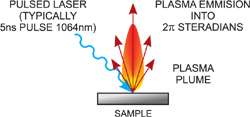
A short laser pulse is focused on to the surface of a sample to create the plasma. A laser with a good Gaussian profile allows focusing to a near diffraction-limited spot. The tighter the focus, the less laser energy is required to produce the laser-induced breakdown. Typically energies of only tens of millijoules are required.
LIBS Plasma Plume

LIBS Plasma plume

The plasma is emitted into >2π steradians, so a fast f/1 lens will collect more light. Sometimes a blocking filter is used to remove any scatter from the incident laser - however, since the incident laser light and the signal are well resolved temporally, a filter is rarely required. An Intensified CCD (ICCD) detector attached to a spectrograph analyzes the collected plasma light.
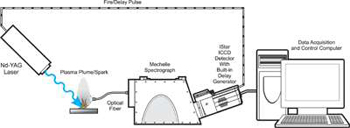
For LIBS, Echelle spectrographs are typically used.For analysis of a wide range of samples, a system based on an echelle spectrograph offers a combination of high resolution and wide wavelength coverage.It is also possible to relay the laser light to the sample and collect the signal by fiber optics. The gating requirements of LIBS are not very demanding. Gate times and delays of several microseconds are typical, so a slow gate ICCD is suitable. The system can usually be operated in internal trigger mode, with the controller board triggering the laser and the delay generator. The intensity of the plasma emission is usually high enough to allow good spectra to be recorded in single scan mode.A typical experimental configuration is shown below.

iStar & Mechelle system for LIBS

Typical LIBS Configuration

LIBS Techniques

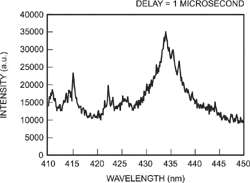
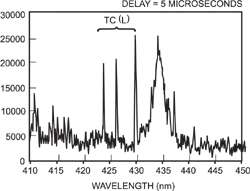
LIBS spectroscopy can be produced from a variety of lasers but typically excimers or pulsed Nd:Yag lasers are used.The high intensity laser pulse interacting with the sample produces a plasma plume that evolves with time from the point of impact of the incident laser pulse. The laser pulse usually lasts for 5 to 20ns.The emission from the plasma plume is collected and analyzed by the detection system.Typically the emission is collected at some distance from the sample to reduce the significance of self-absorption effects or surface effects.The plasma created breaks down all the sample's chemical bonds and ionizes many of the constituent elements.The spectral emission occurs as a result of the subsequent relaxation of the constituent excited species.The spectrum that is observed in the first 100ns is dominated by continuous, intense, white-light radiation; consequently no discrete lines can be observed. The plasma plume expands with time and the excited species relax further.After around 1μs from the incident laser pulse, discrete spectral lines originating from various ionic species start to become visible.The spectra below indicate how the spectral lines evolve over time.The exact timing and the spectral lines vary with the type of sample, the distance from the center of the plasma and the wavelength of the incident laser light, but typically the evolution of the plasma and the changes in its content occur on a microsecond timescale.
Applications of LIBS

LIBS is a useful method for determining the elemental composition of various solids, liquidsand gases.In the LIBS technique, a high power laser pulse is focusedon to a sample to create a plasma or laser spark.Emission from the atoms and ions in the plasma is collected by a lens or fiber optics and analyzed by a spectrograph and gated detector.The atomic spectral lines can be used to determine the elemental composition or theelemental concentrations in the sample.The analysis is similar tothat performed by an ICP (Inductively Coupled Plasma) analyzer.The great appeal of LIBS is that little or no sample preparation is required to obtain useful results and the technique is readily portable to the field.

Spectrum of a solution of potassium pertechnetate

A typical spectrum seen from a solution of potassium pertechnetate dissolved in 0.1 mol l-1nitric acid

LIBS - Atomic emission lines at 5s

At 5μs atomic emission lines start to become visible through the broadened ionic lines

Atomic spectral lines at 10s

At 10µs the atomic spectral lines dominate and clear identification of the atomic species is possible

Andor Solutions for LIBS

Andor Recommended LIBS Cameras

The Andor range of iStar cameras is ideally suited for LIBS, with features like fast or slow gating, wide spectral range, minimum insertion delay and compact detector head. When coupled with a Mechelle spectrometer this would provide an ideal LIBS solution. Based on the Echelle grating principle, this "no moving parts" spectrograph is unique. Combined with an Andor iStar, this patented design achieves the highest bandwidth coverage while simultaneously achieving the highest spectral resolution, without any compromises.

iStar camera

iStar

iStar Options

  • iStar Gen II W type photocathode
  • iStar Gen II WR type photocathode

The iStar offers a wide range of photocathodes and sensor depending on the exact application. Gating for LIBS applications is typically in the microsecond regime so the High QE "W" and "WR" type photocathodes are ideal for LIBS applications.

Andor advantages such as compact detector head, lowest propagation delay, internal delay generator and 25ps step resolution making the iStar the ideal choice for LIBS.

QE curves relevant to LIBS

QE curves relevant to LIBS

Advantages of LIBS

  • Versatile sampling of solids, gases or liquids.
  • Little or no sample preparation is necessary.The result is increased throughput, greater convenience and fewer opportunities for contamination to occur.
  • LIBS typically samples very small amounts of material (~0.1μg to 1mg) and is therefore practically non-destructive.
  • Permits analysis of extremely hard materials that are difficult to digest or dissolve, e.g. ceramics and superconductors.
  • Local analysis in microregions offers a spatial resolving power of ~1-100μm.
  • Possibility of simultaneous multi-elemental analysis.
  • Potential for direct detection in aerosols (a solid or liquid particle in a gaseous medium).
  • Simple and rapid analysis (ablation and excitation processes are carried out in a single step).

Disadvantages of LIBS

  • Increased cost and system complexity.
  • Difficulty in obtaining suitable standards (semi-quantitative).
  • Large interference effects (including matrix interference and, in the case of LIBS in aerosols, the potential interference of particle size).
  • Detection limits are generally not as good as established solution techniques.
  • Poor precision - typically 5-10%, depending on the sample homogeneity, sample matrix, and excitation properties of the laser.
  • Possibility of ocular damage by the high-energy laser pulses.

Case Study

Analysis of Wood Samples from a Crime Scene Using LIBS

The Laboratory of Tree-Ring Science (LTRS) in the Department of Geography,University of Tennessee, received 14 logs from Criminal Investigation Section, Office of the Sheriff, Collin County, Texas. Dr. Madhavi Martin at Oak Ridge National Labs (ORNL) was asked to determine if the logs from the crime scene could have originated from the same tree or from the same location as the logs found at the gathering.

Crime scene graphs - Oak Ridge National Laboratory

Chemical "fingerprints" of wood from crime scene. Courtesy of Dr. Madhavi Martin, Ph.D, Environmental Sciences Division, Oak Ridge National Laboratory, Oak Ridge TN

Through a LIBS technique using an Andor iStar and a Mechelle, Dr. Martin was able to produce a chemical "fingerprint" of wood based on heavy metals and other trace elements. It was subsequently shown that the chemical fingerprint was consistent for all the wood samples that were tested, strongly suggesting that:1) The wood logs come from the same type of tree species.

2) The logs likely came from the same tree or from a group of trees growing in the same area.The results were shown to be 99.999% accurate and supported a successful conviction in this case.

LIBS is a relatively new diagnostic tool, and it has been steadily gaining a lot of importance in the research community. However, issues such as repeatabilty of results, and collection of plasma light still need to be worked on, before LIBS becomes a standard industry tool. New techniques such as Femto-nano Dual-Pulse LIBS has taken LIBS into its next generation, and it has helped to solve a number of issues being faced in this technique. There is a huge potential for LIBS in the industry and military, however more work needs to be done before a standard solution is developed.